

A private equity J-curve is not a forecast of your return. It describes the early period when cash has gone out but investments have not yet produced enough distributions to offset it. For a Portugal Golden Visa investor who pays a qualifying fund subscription upfront, the cash-flow clock may start before the manager has deployed all of that money. That difference matters when comparing a manager's headline IRR with the return on the investor's own cash.
What the J-curve shows
Private equity funds typically acquire assets over time, pay management and operating expenses, then distribute proceeds as investments mature or are sold. Early net cash flow can be negative and reported performance can be weak before realizations arrive. The pattern is common, but neither its depth nor its recovery date is predictable. The CFA Institute's explanation of the J-curve distinguishes the investor's cash position from an IRR-based performance curve.
Why the Golden Visa investor's funding date matters
An institutional limited partner often commits a sum and pays it in later capital calls. A Golden Visa applicant using the fund route instead needs to document an actual qualifying transfer and acquisition of fund units; AIMA describes the EUR 500,000 fund route and its evidence requirements. In practice, a Golden Visa subscription may therefore be funded upfront, even if the manager will invest the fund's cash gradually. Check the fund documents and your immigration counsel's requirements rather than assuming every fund uses the same funding schedule.
| Question | Staged capital-call investor | Upfront-funded investor |
|---|---|---|
| When does cash leave the investor? | As capital is called | At subscription, if paid in full |
| When does the manager invest in assets? | According to deal activity | According to deal activity |
| What cash might wait before deployment? | Uncalled commitment remains with the investor | Subscribed cash may remain inside the fund |
| Which return should be compared? | Net return on dated capital calls | Net return on the investor's dated subscription and distributions |
This is a timing difference, not proof that one fund or investor class will earn a particular return. If the same eventual distributions are received later relative to an earlier payment, investor-level annualized IRR will generally be lower. The exact result depends on fees, distributions and the cash-flow dates. A high fund-level or deal-level IRR need not be the investor's net IRR. The ILPA performance template is useful context for asking managers to show contributions and distributions consistently.
Read the illustrations as cash flow, not promised performance
The charts below use hypothetical amounts to contrast staged and upfront payments. Their year-by-year distributions are assumed, not estimates for a Portuguese fund. They show cumulative net cash flow, which is related to but not the same as IRR, TVPI or a valuation of the remaining portfolio.
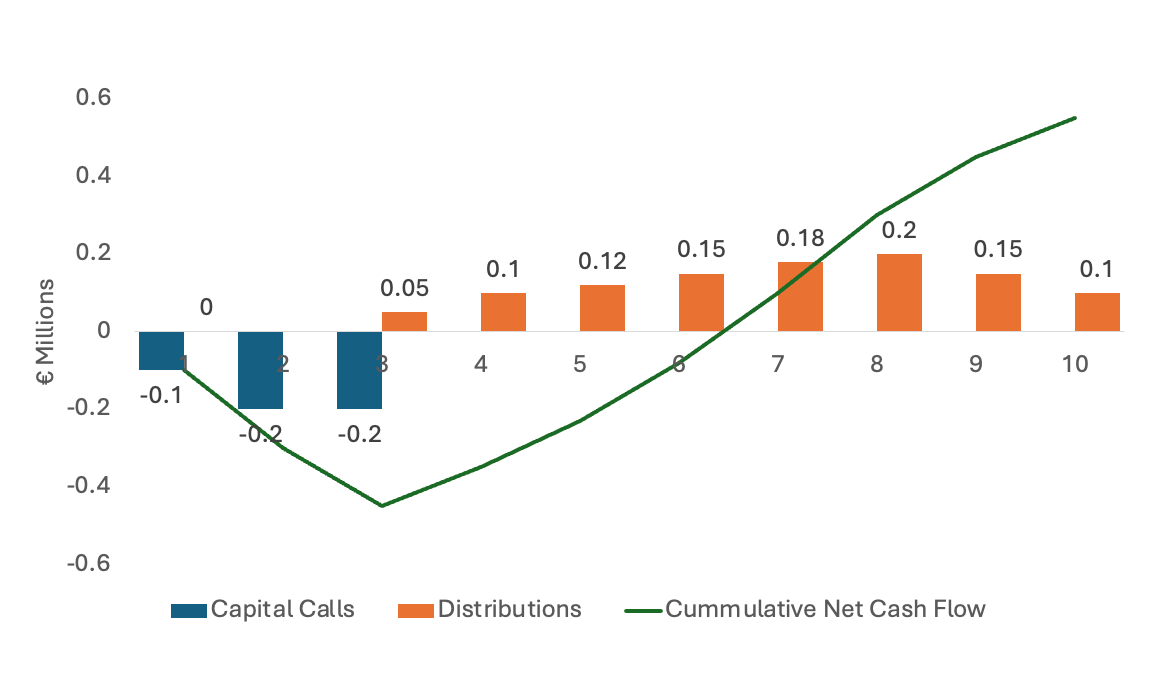
Illustration A: staged payments. The investor retains uncalled cash until the fund requests it.
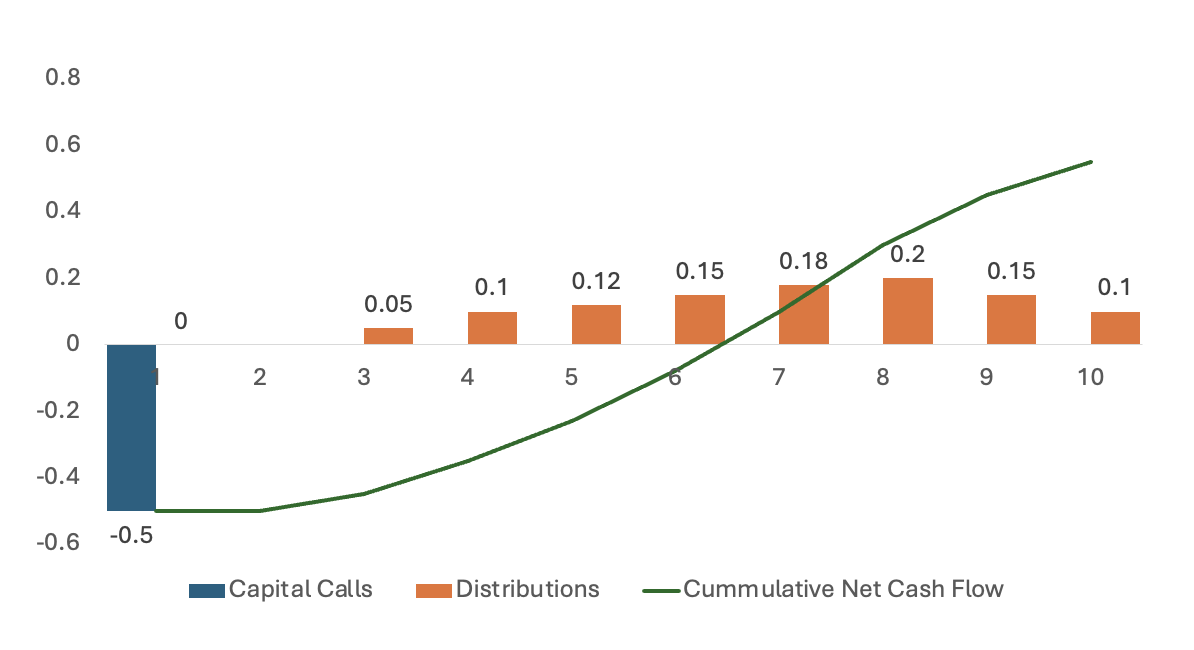
Illustration B: upfront payment. The investor's entire subscription leaves at the start of this example.
The drawings do not establish a typical breakeven year, a ten-year fund life, or an expected distribution schedule. An early distribution can also affect the investor's immigration position, depending on how it is structured. Obtain fund-specific documents and legal advice before treating a projected payment as available to spend or reinvest.
Ask for the investor-level numbers
- Dated cash flows: When will you pay, and when might the fund distribute? Ask for a net-to-investor scenario, not only gross portfolio returns.
- Deployment and cash drag: What share of subscribed capital is invested today? Where is undeployed cash held, and what fees apply while it waits?
- Multiple measures: Compare IRR with TVPI (distributed plus remaining value divided by paid-in capital) and DPI (cash distributed divided by paid-in capital). Unrealized value is an estimate, not cash returned.
- Distribution policy: Can proceeds be recycled? Does the fund distribute income, return capital, or both? Check the waterfall and the effect of fees and carry.
- Immigration and tax treatment: Ask qualified advisers whether a proposed distribution or reduction of fund units affects your qualifying investment, residence status or tax position. A label such as "dividend" is not by itself a compliance guarantee.
For a deeper worked example, see our guide to private equity return metrics and return simulator. The Golden Visa Funds Database helps organize the documents and comparison questions; it is an educational research tool, not a fund recommendation.
Frequently asked questions
What is the private equity J-curve?
It describes how early fees, investment spending and limited exits can produce negative net cash flow or weak reported returns before later distributions and realizations improve the picture. The shape and timing are not guaranteed.
Why can my J-curve differ from the manager's fund-level chart?
If you pay upfront while the manager deploys gradually, your cash leaves earlier than the underlying investments are made. A return calculated from your actual payment date can therefore differ from a metric based on later capital calls or portfolio-company cash flows.
Does an upfront subscription always mean a lower return?
No. It changes cash-flow timing, not the eventual investment outcome by itself. Deployment speed, fees, distributions, asset performance and the precise metric being compared all matter.
Which figures should I request before comparing funds?
Ask for dated investor-level net cash flows, paid-in capital, distributions, remaining value, fees and assumptions. Compare net IRR alongside TVPI and DPI, and ask how much subscribed capital is actually deployed.