
Why Standard PE Returns Don’t Apply to Golden Visa Investors (And How to Spot the Hidden Traps)
If you are evaluating Portugal Golden Visa–eligible private equity funds, you have likely noticed a discrepancy: the returns projected in the marketing brochure don’t always match the reality of a Golden Visa investor.
The reason isn't malice—it’s mechanics. And more importantly, nuance.
Most private equity models assume you are an Institutional Investor with a full legal team to negotiate terms and dissect the "distribution waterfall." But as a private Golden Visa investor, you are often presented with a complex 200-page Private Placement Memorandum (PPM) and left to figure out the fine print alone.
We built our Private Equity Funds Return Simulator to bridge this gap. It is the first tool designed to decode these legal definitions and show you exactly how different fund rules affect your bank account.
The "Fine Print" Variations: A €100k Example
It is not enough to know the "Hurdle Rate" or the "Management Fee." The real impact on your return comes from how those numbers are defined. These definitions vary wildly from fund to fund.
Here are the specific nuances our simulator models—and why you need to watch out for them:
1. The Subscription Fee: Deducted vs. On Top
Most GV funds charge a subscription fee (e.g., 3%). But where does that money come from?
- Deducted: You commit €100k. The fund takes €3k in fees and only invests €97k.
- On Top: You commit €100k but must wire €103k. The full €100k is invested.
- The Nuance: This changes your initial cash outflow and, crucially, the amount of capital actually working for you.
2. The Return of Capital (ROC) Base
Before profits are split, you get your money back. But which money?
- Committed Base: The fund must return your full €100k (gross) before the manager takes any performance fee.
- Net Base: The fund only needs to return the €97k (net invested) before taking performance fees.
- The Nuance: In the "Net Base" scenario, the manager enters the profit-sharing phase sooner, which can reduce your total payout.
3. The Preferred Return Base
You are promised a "Preferred Return" (Hurdle) of, say, 6%. But 6% of what?
- On Committed: You earn 6% on the full €100k.
- On Net: You earn 6% only on the €97k actually invested.
- The Nuance: Over a 7-10 year fund life, earning interest on that "missing" €3k compounds into a significant difference.
4. The "Accrual Anchor" (When the Clock Starts)
This is one of the most overlooked variables. When does your 6% Preferred Return start ticking?
- Subscription (Paid In): The clock starts the moment you wire your money.
- First Deployment: The clock only starts months (or years) later, when the fund makes its first investment.
- The Nuance: With the "Cash Drag" of the Golden Visa (where money sits idle initially), a "First Deployment" rule can wipe out 12–18 months of accrued returns you thought you were guaranteed.
5. Distribution Proration
When the fund sells an asset, how is the cash split among investors?
- Pro-Rata on Committed: Your share is calculated based on your headline €100k commitment.
- Pro-Rata on Net: Your share is calculated based on your €97k net capital.
- The Nuance: If you are in a fund with mixed investor classes (some paying fees on top, some deducted), this definition determines the size of your slice of the pie.
6. The GP Catch-Up
Most funds include a "Full Catch-Up." This means that once you receive your Preferred Return (Hurdle), the manager (GP) gets 100% of the next slice of profits until they "catch up" to their 20% carry share.
- The Nuance: While standard, the interaction between the Catch-Up and the Hurdle Rate is explosive. If the fund barely clears the hurdle, the Catch-Up mechanism can aggressively transfer the remaining profit to the manager, leaving you with exactly the hurdle and nothing more.
See It in Action
These variables are complex, and they interact with each other. A "Net Base" combined with a "First Deployment" anchor produces a radically different outcome than a "Committed Base" with "Paid In" accrual.
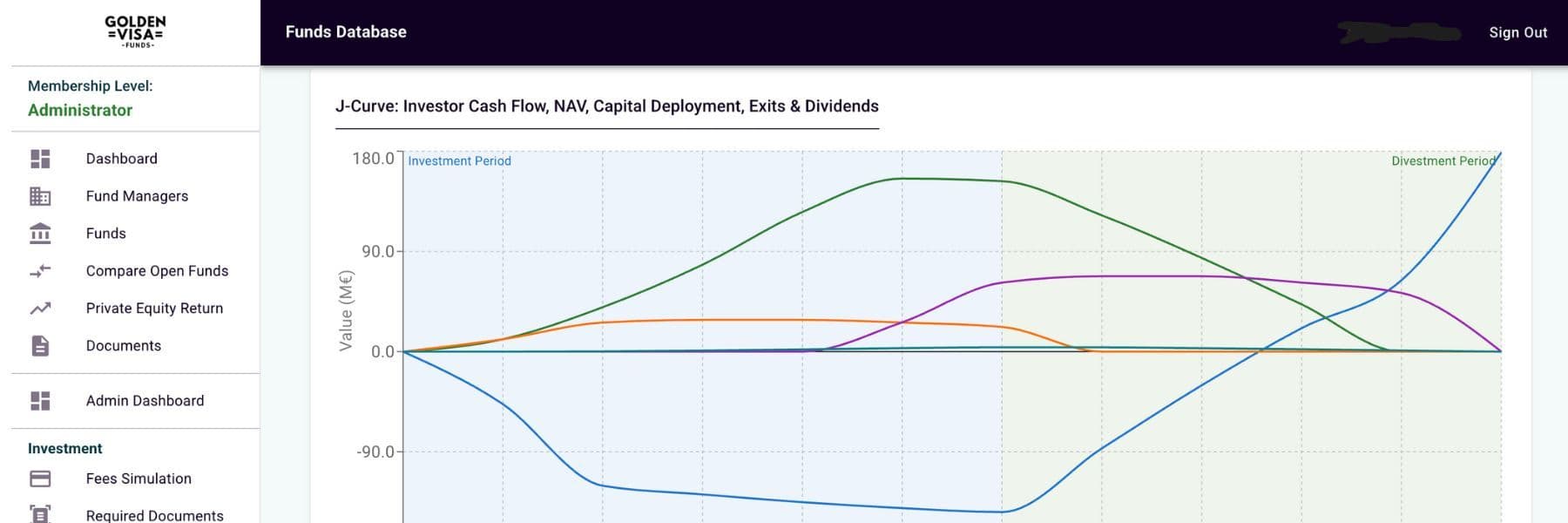
We have recorded a short visual walkthrough to show how toggling these specific settings changes the J-Curve and your final distribution.
You Don't Have an Institutional Analyst Team. (But We Can Help.)
Navigating these legal variations is difficult for private investors. The difference between "Committed" and "Net" might look like a single word in a legal document, but it represents thousands of euros in your final return.
This simulator is part of our Golden Visa Funds Database, a premium tool for investors who want data, not just brochures.
If you are unsure how a specific fund’s fee structure, accrual definitions, or waterfall affect your net outcome, book an initial consultation. We can load the specific assumptions of the funds you are considering into our database and walk you through the realistic outcomes side-by-side.